Search by medicine name. Napa OR Alatrol OR Amodis
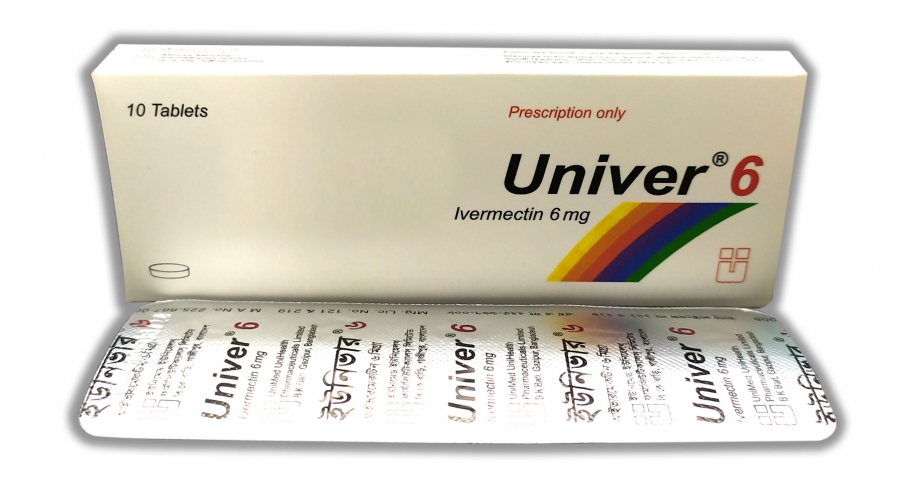
Univer 6mg
TabletIvermectin (Oral)
Unimed Unihealth MFG. Ltd
Other Strength:
Alternative:
- A-Mectin 6mg
- Parakil 6mg
- Alice 6mg
- Imec 6mg
- Veratin 6mg
- Iverum 6mg
- Ivactin 6mg
Univer
Presentation
Univer 6 tablet: White, round shaped tablet; each tablet contains Ivermectin USP 6mg.
Indications
Ivermectin is indicated for the treatment of:
onchocerciasis and intestinal strongyloidiasis (anguillulosis).
crusted scabies in conjunction with topical therapy.
human sarcoptic scabies when prior topical treatment has failed or is contraindicated.
Treatment is only justified when the diagnosis of scabies has been established clinically and/or by parasitological examination. Without formal diagnosis, treatment is not justified in case of pruritus alone.
Dosage and administration
Treatment is administered as a single oral dose given with water. The dose is determined by the patient’s weight as shown below.
Strongyloidiasis- the dosage aims to provide approximately 200 µg ivermectin/kg body weight.
Sarcoptes scabiei (scabies) – the dosage aims to provide approximately 200µg ivermectin/kg body weight per dose.
Contraindications
Hypersensitivity to any component of the product.
Precautions
If any hypersensitivity reaction to this product occurs, no further dose should be given.
Effects on fertility:
No data are available.
For treatment of onchocerciasis:
Ivermectin should be used only when infections with O. volvulus have been diagnosed or are suspected. No data are available to support its use prophylactically.
After treatment with microfilaricidal drugs, patients with hyperreactive onchodermatitis (sowda) may be more likely than others to experience severe adverse reactions, especially oedema and aggravation of onchodermatitis.
Rarely, patients with onchocerciasis who are also heavily infected with Loa Loa may develop a serious or even fatal encephalopathy either spontaneously or following treatment with an effective microfilaricide. In these patients, the following adverse experiences have also been reported: pain (including neck and back pain), red eye, conjunctival haemorrhage, dyspnoea, urinary and/or faecal incontinence, difficulty in standing/walking, mental status changes, confusion, lethargy, stupor, seizures or coma. This syndrome has been seen very rarely following the use of ivermectin.
Impaired Renal or Hepatic function:
Ivermectin has not been studied in patients with impaired hepatic function or impaired renal function. As ivermectin is extensively metabolised by the liver, caution should be exercised if ivermectin is administered to patients with impaired hepatic function.
Use in Pregnancy (Category B3):
Ivermectin should not be used in pregnancy as safety in pregnancy has not been established. Ivermectin caused cleft palates in mice and rats at oral doses of 0.4 and 10 mg/kg/day respectively, and cleft palates and clubbed feet in rabbits dosed at 3 mg/kg/day.
Use in Lactation:
Ivermectin is excreted in breast milk and safety in newborn infants has not been established. Inrats, reduced survival occurred in control pups and pups exposed in utero that were cross-fostered to treated dams.
The drug should be given to nursing mothers only if the benefit to the mother outweighs the potential risk to the breast-fed infant, and the treatment of mothers who intend to breast-feed their infants should be delayed until at least one week after the birth of the child.
Carcinogenicity/Mutagenicity:
There have been no carcinogenicity studies with ivermectin. Ninety-four and 105 week carcinogenicity studies on mice and rats respectively were conducted with the closely related compound abamectin and were negative at up to 8 mg/kg/day in mice and up to 2 mg/kg/day in rats. Ivermectin was negative in three in vitro assays for geno toxicity (mutagen assays in bacteria and mouse cells, and unscheduled DNA synthesis in human cells). No tests have been done to test the potential of ivermectin for producing clastogenicity.
Paediatric Use:
Onchocerciasis:
Ivermectin should not be used in children under five years of age as safety in this age group has not been established.
The safety profile of ivermectin in children 5 to 12 years of age is similar to that observed in adults.
Strongyloidiasis:
Efficacy has not been established in children under twelve years of age.
Sarcoptes scabiei (scabies):
Ivermectin should not be used in children under 15 kg and under 5 years of age as safety in these groups has not been established.
Use in the Elderly:
Clinical studies of ivermectin did not include sufficient numbers of elderly subjects aged 65 years and over to determine whether they respond differently from younger subjects. In general, treatment of elderly patients should be cautious, reflecting the greater frequency of decreased hepatic, renal or cardiac function, and of concomitant disease or other drug therapy.
Interactions with other medicines:
Interactions between ivermectin and other drugs have not been studied in clinical trials.
Very rare post-marketing reports of increased INR (International Normalised Ratio) have been reported when ivermectin was co-administered with warfarin.
Adverse effects
Strongyloidiasis:
Ivermectin has been demonstrated to be generally well tolerated in the treatment of
strongyloidiasis.
In three clinical studies involving a total of 109 patients given either one or two doses of 170-200µg/kg of ivermectin, the following adverse reactions were reported as possibly, probably, or definitely related to ivermectin:
Body as a whole: asthenia/fatigue (0.9%), abdominal pain (0.9%)
Gastrointestinal: anorexia (0.9%), constipation (0.9%), diarrhoea (1.8%), nausea (1.8%), vomiting (0.9%)
Nervous System/Psychiatric: dizziness (2.8%), somnolence (0.9%), vertigo (0.9%), tremor (0.9%)
Skin: pruritus (2.8%), rash (0.9%), and urticaria (0.9%)
Onchocerciasis:
Ivermectin has been demonstrated to be generally well tolerated in the treatment of onchocerciasis.
In clinical trials involving 963 adult patients treated with 100 to 200 µg/kg ivermectin and 315 patients on placebo, worsening of the following Mazzotti-type reactions during the first 4 days posttreatment were reported (ivermectin, placebo, respectively): arthralgia/synovitis (9.3%, 4.4%), axillary lymph node enlargement (11.0%, 2.9%), axillary lymph node tenderness (4.4%, 1.0%), cervical lymph node enlargement (5.3%, 4.1%), cervical lymph node tenderness (1.2%, 0.6%), inguinal lymph node enlargement (12.6%, 6.7%), inguinal lymph node tenderness (13.9%, 5.7%), other lymph node enlargement (3.0%, 1.6%), other lymph node tenderness (1.9%, 0.6%), pruritus (27.5%, 17.2%), skin involvement including oedema, papular and pustular or frank urticarial rash (22.7%, 9.2%), and fever (22.6%, 4.8%).
In clinical trials, ophthalmological conditions were examined in 963 adult patients before treatment, at day 3 and months 3 and 6 after treatment with 100 to 200 mg/kg ivermectin. Changes observed were primarily deterioration from baseline 3 days post-treatment. Most changes either returned to baseline condition or improved over baseline severity at the month 3 and 6 visits. The percentages of patients with worsening of the following conditions at day 3, month 3 and 6, respectively, were: limbitis: 5.5%, 4.8%, and 3.5% and punctate opacity: 1.8%, 1.8%, and 1.4%. The corresponding percentages for patients treated with placebo were: limbitis: 6.2%, 9.9% and 9.4% and punctate opacity: 2.0%, 6.4% and 7.2%.
In clinical trials involving 963 adult patients who received 100 to 200 mg/kg ivermectin and 315 patients on placebo, the following clinical adverse reactions were reported as possibly, probably, or definitely related to the drug in 1% of the patients (ivermectin and placebo, respectively): facial oedema (1.2%, 0%), peripheral oedema (3.2%, 0.6%), orthostatic hypotension (1.1%, 0%), and tachycardia (3.5%, 0.6%). Drug-related headache and myalgia occurred in < 1% of patients given ivermectin (0.2%, and 0.4%, respectively). However, these were the most common adverse experiences reported overall during these trials regardless of causality (22.3%, and 19.7%, respectively).
Sarcoptes scabiei (scabies):
Adverse effects reported in the literature review were similar to those reported in clinical trials. The most common adverse drug reactions reported with ivermectin in the review involved the transient exacerbation of pruritus that can sometimes occur as a result of sensitisation of the human host to mite antigens, with a consequent immunologic reaction (1.4%). Sensitisation also frequently results in delayed resolution of symptoms. Patients should be warned
that itching may persist for one to two weeks after treatment, even if the mite is successfully eradicated. Other frequently reported reactions consisted of headache (< 1.0%), arthralgia (< 1.0%) and anorexia (< 1.0%). Additionally, lethargy (< 1.0%), listlessness (< 1.0%), abdominal discomfort (< 1.0%), rash (< 1.0%), and dizziness (< 1.0%) were reported.
Overdosage
There are reports of accidental overdosing of ivermectin, but no fatalities have been attributable to ivermectin overdosing. In significant accidental intoxication with unknown quantities of a veterinary formulation, symptoms have resembled those seen in animal toxicology studies, which were chiefly rash, contact dermatitis, oedema, headache, dizziness, asthenia, nausea, vomiting, diarrhoea, mydriasis, somnolence, depressed motor activity, tremors and ataxia. Other adverse effects that have been reported include: seizure, dyspnoea, abdominal pain, paraesthesia and urticaria. In case of accidental poisoning, supportive therapy, if indicated, should include parenteral fluids and electrolytes, respiratory support (oxygen and mechanical ventilation if necessary) and pressor agents if clinically significant hypotension is present. Induction of emesis and/or gastric lavage as soon as possible, followed by purgatives and other routine antipoison measures may be indicated if needed to prevent absorption of ingested material. Although data are not available for man, it would appear advisable to avoid GABA-agonistic drugs in the treatment of accidental ivermectin intoxication. In a study in which healthy volunteers were orally administered up to 2000 µg/kg ivermectin in a fasted state or up to 600 µg/kg ivermectin following a high-fat (48.6 g of fat) meal, there were no indications of central nervous system toxicity observed at any dose irrespective of food intake.
Pharmaceutical precautions
Store below 30ºC temperature in a cool and dry place, protected from light.
Packaging quantities
Univer 6 tablet: Each box contains 10 tablets in Alu-PVDC blister pack.
এই পাতাটি ৩০০ বার দেখা হয়েছে