ঔষধের বিস্তারিত বা বিকল্প ঔষধ জানতে ঔষধের নাম দিয়ে সার্চ দিন। যেমন- Napa বা Alatrol বা Amodis
Rupahist 10mg
Tablet
Rupatadine Fumarate Unimed Unihealth MFG. Ltd
Other Strength:
Alternative:
- RUPASTIN 10mg
- Rupex 10mg
- Rupatrol 10mg
- Rosela 10mg
- Alarup 10mg
- Largix 10mg
- Rupin 10mg
- Rupaler 10mg
- Rupa 10mg
- Rubest 10mg
- Stark 10mg
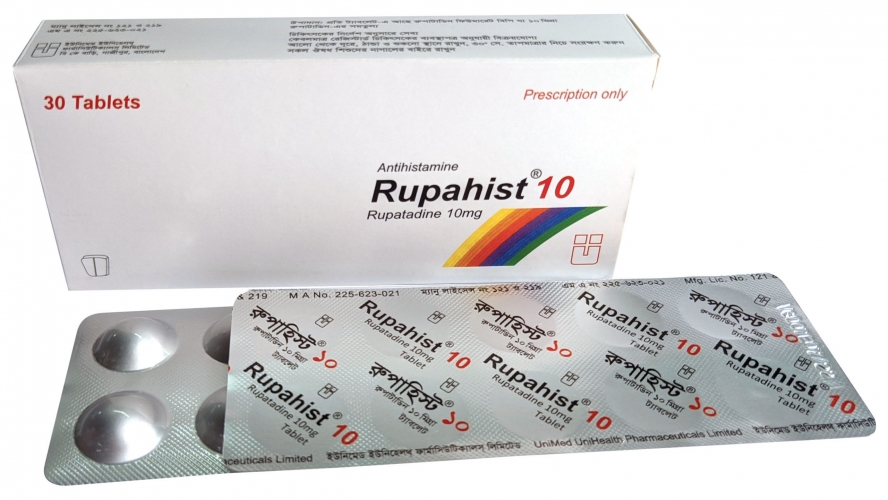 Rupahist
Presentation
Rupahist® 10 tablet: Round, orange coloured tablet; Each tablet contains Rupatadine Fumarate BP equivalent to Rupatadine 10 mg.
Indication
Symptomatic treatment of allergic rhinitis and urticaria in adults and adolescents (over 12 years of age).
Dose and administration
Adults and adolescents (over 12 years of age): The recommended dose is 10 mg (one tablet) once a day, with or without food.
Elderly: Rupahist® should be used with caution in elderly people.
Paediatric patients: Rupahist® 10 mg tablets is not recommended for use in children below age 12.
Patients with renal or hepatic insufficiency: As there is no clinical experience in patients with impaired kidney or liver functions, the use of Rupahist® 10 mg tablet is at present not recommended in these patients.
Contra-indication, warning etc.
Contra-indication: Hypersensitivity to the active substance or to any of the excipients.
Special warnings and precautions for use: The administration of Rupatadine with grapefruit juice is not recommended. The combination of Rupatadine with potent CYP3A4 inhibitors should be avoided and with moderate CYP3A4 inhibitors should be administered with caution. Dose adjustment of sensitive CYP3A4 substrates (e.g. simvastatin, lovastatin) and CYP3A4 substrates with a narrow therapeutic index (e.g. ciclosporin, tacrolimus, sirolimus, everolimus, cisapride) could be required as Rupatadine may increase plasma concentrations of these drugs. Cardiac safety of Rupatadine was assessed in a Thorough QT/QTc study. Rupatadine up to 10 times therapeutic dose did not produce any effect on the ECG and hence raises no cardiac safety concerns. However, Rupatadine should be used with caution in patients with known prolongation of the QT interval, patients with uncorrected hypokalemia, patients with ongoing proarrhythmic conditions, such as clinically significant bradycardia, acute myocardial ischemia. Rupatadine 10 mg tablet should be used with caution in elderly patients (65 years and older). Although no overall differences in effectiveness or safety were observed in clinical trials, higher sensitivity of some older individuals cannot be excluded due to the low number of elderly patients enrolled.
Drug Interactions: Interaction studies have only been performed in adults and adolescents (over 12 years of age) with Rupatadine 10 mg tablets.
Effects of other drugs on Rupatadine: Co-administration with potent CYP3A4 inhibitors (e.g. itraconazole, ketoconazole, voriconazole, posaconazole, HIV protease inhibitors, clarithromycin, nefazodone) should be avoided and co-medication with moderate CYP3A4 inhibitors (erythromycin, fluconazole, diltiazem) should be used with caution. The concomitant administration of Rupatadine 20 mg and ketoconazole or erythromycin increases the systemic exposure to Rupatadine 10 times and 2-3 times respectively. These modifications were not associated with an effect on the QT interval or with an increase of the adverse reactions in comparison with the drugs when administered separately. The concomitant administration of grapefruit juice increased 3.5 times the systemic exposure of Rupatadine. Grapefruit juice should not be taken simultaneously. Caution should be taken when Rupatadine is co-administered with other metabolised drugs with narrow therapeutic windows since knowledge of the effect of Rupatadine on other drugs is limited. After administration of alcohol, a dose of 10 mg of Rupatadine produced marginal effects in some psychomotor performance tests although they were not significantly different from those induced by intake of alcohol only. A dose of 20 mg increased the impairment caused by the intake of alcohol. As with other antihistamines, interactions with CNS depressants cannot be excluded. Asymptomatic CPK increases have been uncommonly reported in Rupatadine clinical trials. The risk of interactions with statins, some of which are also metabolised by the cytochrome P450 CYP3A4 isoenzyme, is unknown. For these reasons, Rupatadine should be used with caution when it is co-administered with statins.
Pregnancy & lactation: There are limited amount of data from the use of Rupatadine in pregnant women. As a precautionary measure, it is preferable to avoid the use of Rupatadine during pregnancy. It is unknown whether Rupatadine is excreted into breast milk. A decision must be made whether to discontinue breastfeeding or to discontinue/abstain from Rupatadine therapy taking into account the benefit of breastfeeding for the child and the benefit of therapy for the woman.
Overdose: No case of overdose has been reported. In a clinical safety study Rupatadine at daily dose of 100 mg during 6 days was well tolerated. The most common adverse reaction was somnolence. If accidental ingestion of very high doses occurs symptomatic treatment together with the required supportive measures should be given.
Undesirable effects: The most common adverse reactions in controlled clinical studies were somnolence, headache and fatigue. The majority of the adverse reactions observed in clinical trials were mild to moderate in severity and they usually did not require cessation of therapy. Adverse reactions are somnolence, headache, dizziness, dry mouth, fatigue and asthenia, pharyngitis, rhinitis, increased appetite, disturbance in attention, epistaxis, nasal dryness, cough, dry throat, oropharyngeal pain, nausea, abdominal pain upper, diarrhoea, dyspepsia, vomiting, abdominal pain, constipation, rash, back pain, arthralgia, myalgia, thirst, malaise, pyrexia and irritability.
Pharmaceutical precautions
Keep the blister in the inner carton in order to protect from light.
Packaging quantity
Rupahist® 10 tablet: Carton containing 30 tablets in alu-alu blister.
এই পাতাটি ৬৪৪ বার দেখা হয়েছে