ঔষধের বিস্তারিত বা বিকল্প ঔষধ জানতে ঔষধের নাম দিয়ে সার্চ দিন। যেমন- Napa বা Alatrol বা Amodis
Risdon 4mg
Tablet
Risperidone (Oral) Unimed Unihealth MFG. Ltd
Other Strength:
- Risdon 1mg
- Risdon 2mg
Alternative:
- Residon 4mg
- Risomax 4mg
- Sperid 4mg
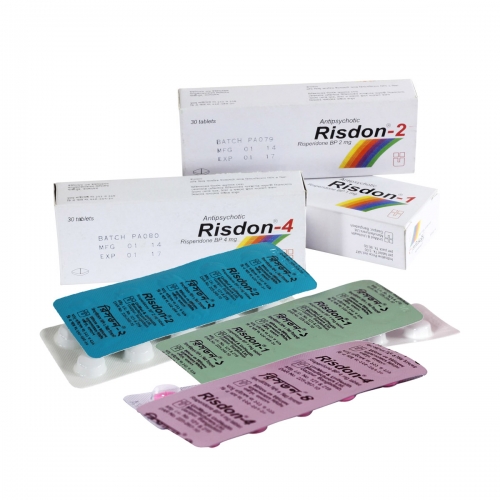 Risdon
Presentation
Risdon-1 tablet: Green, diamond shaped, film coated, scored tablet; each tablet contains Risperidone BP 1 mg.
Risdon-2 tablet: Blue, diamond shaped, film coated, scored tablet; each tablet contains Risperidone BP 2 mg.
Risdon-4 tablet: Pink, diamond shaped, film coated, scored tablet; each tablet contains Risperidone BP 4 mg.
Indications
Risdon (Risperidone) tablet is indicated for the treatment of acute and chronic schizophrenic psychoses, and other psychotic conditions, in which positive symptoms (such as hallucinations, delusions, thought disturbances, hostility, suspiciousness), and/or negative symptoms (such as blunted affect, emotional and social withdrawal, poverty of speech) are prominent. Risdon (Risperidone) also alleviate affective symptoms (such as depression, guilt feelings, anxiety) associated with schizophrenia. Risdon (Risperidone) is also effective inmaintaining the clinical improvement during continuation therapy in patients who have shown an initial treatment response. Risdon (Risperidone) is in dicated for the treatment of mania in bipolar disorder.
Dosage and administrations
Schizophrenia
Switching from other antipsychotics: where medically appropriate, gradual discontinuation of the previous treatment while Risdon (Risperidone) therapy is initiated is recommended. The need for continuing existing antiparkinson medication should be re-evaluated periodically.
Adults: Risdon (Risperidone) may be given once or twice daily. All patients, whether acute or chronic, should start with 2 mg/day (one Risdon-2 tablet once daily or one Risdon-1 tablet twice daily). The dosage may be increased to 4 mg/day on the second day. Some patients, such as first episode patients, may benefit from a slower rate of titration. From then on the dosage can be maintained unchanged, or further individualised, if needed. Most patients will benefit from daily doses between 4 and 6 mg/day although in some, an optimal response may
be obtained at lower doses.
Elderly: A starting dose of 0.5 mg (half one Risdon-1 tablet) twice daily is recommended. This dosage can be individually adjusted with 0.5 mg (half one Risdon-1 tablet) twice daily increments to 1 to 2 mg (one Risdon-1 or Risdon-2 tablet) twice daily.
Children: Use of Risperidone for schizophrenia in children aged less than 15 years has not been formally evaluated. Renal and liver disease: A starting dose of 0.5 mg (half one Risdon-1 tablet) twice daily is recommended. This dosage can be individually adjusted with 0.5 mg (half one Risdon-1 tablet) twice daily increments to 1 to 2 mg twice daily (one Risdon-1 or Risdon-2 tablet). Risperidone should be used with caution in this group of patients until further experience is gained. Bipolar Mania
Adults: Risdon (Risperidone) should be administered on a once daily schedule, starting with 2 mg (one Risdon-2 tablet). Dosage adjustments, if indicated, should occur at intervals of not less than 24 hours and in dosage increments of 1 mg/day. A dosing range between 1 and 6 mg per day is recommended.
Elderly: A starting dose of 0.5 mg (half one Risdon-1 tablet) twice daily is recommended. This dosage can be individually adjusted with 0.5 mg (half one Risdon-1 tablet) twice daily increments to 1 to 2 mg (one Risdon-1 or Risdon-2 tablet) twice daily.
Renal and liver disease: A starting dose of 0.5 mg twice daily is recommended. This dosage can be individually adjusted with 0.5 mg (half one Risdon-1 tablet) twice daily increments to 1 to 2 mg (one Risdon-1 or Risdon-2 tablet) twice daily.
Combined use with mood stabilisers: There is limited information on the combined use of Risperidone with Carbamazepine in bipolar mania. Carbamazepine has been shown to induce the metabolism of Risperidone producing lower plasma levels of the antipsychotic fraction of Risperidone. It is therefore not recommended to co-administer Risperidone with Carbamazepine in bipolar mania patients until further experience is gained. The combined use with lithium or valproate does not require any adjustment of the dose of Risperidone.
Contra-indications, warnings,etc.
Contra-indications: Risperidone tablets are contra-indicated in patients with a known hypersensitivity to Risperidone. Special precautions
Elderly patients with dementia: Elderly patients with dementia treated with atypical antipsychotic drugs had an increased mortality compared to placebo. Dehydration was an overall risk factor for mortality and should therefore Risperidone be carefully avoided in elderly patients with dementia. Cerebrovascular adverse events (CVAE): Risperidone is not recommended for the treatment of behavioural symptoms of dementia because of an increased risk of cerebrovascular adverse events (including cerebrovascular accidents and transient ischaemic attacks).
Alpha-blocking activity: Due to the alpha-blocking activity of Risperidone, orthostatic hypotension can occur, especially during the initial dose-titration period. A dose reduction should be considered if hypotension occurs.
Tardive Dyskinesia/Extrapyramidal Symptoms (TD/EPS): Drugs with dopamine receptor antagonistic properties have been associated with the induction of tardive dyskinesia, characterised by rhythmical involuntary movements, predominantly of the tongue and/or face. It has been reported that the occurrence of extrapyramidal symptoms is a risk factor for the development of tardive dyskinesia. If signs and symptoms of tardive dyskinesia appear, the discontinuation of all antipsychotic drugs should be considered.
Neuroleptic Malignant Syndrome (NMS): Neuroleptic malignant syndrome, characterised by hyperthermia, muscle rigidity, autonomic instability, altered consciousness and elevated CPK levels, has been reported to occur with neuroleptics. In this event all antipsychotic drugs including Risperidone should be discontinued. Caution should also be exercised when prescribing Risperidone to patients with Parkinson’s disease since, theoretically, it may cause a deterioration of the disease.
Hyperglycemia: Hyperglycemia or exacerbation of pre-existing diabetes has been reported in very rare cases during treatment with Risperidone. Appropriate clinical monitoring is advisable in diabetic patients and in patients with risk factors for the development of diabetes mellitus.
Others: Classical neuroleptics are known to lower the seizure threshold. Caution is recommended when treating patients with epilepsy. As with other antipsychotics, patients should be advised of the potential for weight gain. Acute withdrawal symptoms, including nausea, vomiting, sweating, and insomnia have very rarely been described after abrupt cessation of high doses of antipsychotic drugs. Recurrence of psychotic symptoms may also occur, and the emergence of involuntary movement disorders (such as akathisia, dystonia and dyskinesia) has been reported. Therefore, gradual withdrawal is advisable. Use of Risperidone for schizophrenia in children aged less than 15 years has not been formally evaluated.
Drug interactions: Possible interactions of Risperidone with other drugs have not been systematically evaluated. Given the primary CNS effects of Risperidone, it should be used with caution in combination with other centrally acting drugs including alcohol. On initiation of Carbamazepine or other hepatic enzyme-inducing drugs, the dosage of Risperidone should be reevaluated and increased if necessary. Conversely, on discontinuation of such drugs, the dosage of Risperidone should be re-evaluated and decreased if necessary. When concomitant Fluoxetine or Paroxetine is initiated or discontinued, the physician should re-evaluate the dosing of Risperidone. Risperidone does not show a clinically relevant effect on the pharmacokinetics of Valproate or Topiramate. Food does not affect the absorption of Risperidone from the stomach.
Use in pregnancy and lactation: The safety of Risperidone for use during human pregnancy has not been established. Reversible extrapyramidal symptoms in the neonate were observed following use of Risperidone during the last trimester of pregnancy. Therefore, Risperidone should only be used during pregnancy if the benefits outweigh the risks. Women receiving Risperidone should not breast feed.
Warnings: Risperidone may interfere with activities requiring mental alertness. Therefore, patients should be advised not to drive or operate machinery until their individual susceptibility is known.
Side-effects: Risperidone is generally well tolerated and in many instances it has been difficult to differentiate adverse events from symptoms of the underlying disease. Insomnia, agitation, anxiety, headache, somnolence, fatigue, dizziness, impaired concentration, constipation, dyspepsia, nausea/vomiting, abdominal pain, blurred vision, priapism, erectile dysfunction, ejaculatory dysfunction, orgasmic dysfunction, urinary incontinence, rhinitis, rash, galactorrhoea, gynaecomastia, disturbances of the menstrual cycle, amenorrhoea, weight gain, oedema,
increased hepatic enzyme levels and other allergic reactions have been observed during treatment with Risperidone. In some cases the following extrapyramidal symptoms may occur: tremor, rigidity, hypersalivation, bradykinesia, akathisia, acute dystonia including oculogyric crisis. Benign pituitary adenomas and angioedema have been reported very rarely in Risperidone users. Sedation has been reported more frequently in children and adolescents than in adults.
Overdose: Drowsiness, sedation, tachycardia, hypotension, and extrapyramidal symptoms may occur. In case of severe extrapyramidal symptoms, anticholinergic medication should be administered. Close medical supervision and monitoring should continue until the patient recovers. There is no specific antidote to Risperidone.
Pharmaceutical precautions
Store in a cool and dry place, protected from light.
Packaging quantities
Risdon-1 tablet: Carton containing 30 tablets in blister.
Risdon-2 tablet: Carton containing 30 tablets in blister.
Risdon-4 tablet: Carton containing 30 tablets in blister.
এই পাতাটি ২৬৮ বার দেখা হয়েছে