ঔষধের বিস্তারিত বা বিকল্প ঔষধ জানতে ঔষধের নাম দিয়ে সার্চ দিন। যেমন- Napa বা Alatrol বা Amodis
Hemotrax 500mg
Tablet
Tranexamic Acid Unimed Unihealth MFG. Ltd
Other Strength:
Alternative:
- TRACID 500mg
- Trexam 500mg
- Anaxyl 500mg
- Tranexil 500mg
- Intrax 500mg
- Frabex 500mg
- Xamic 500mg
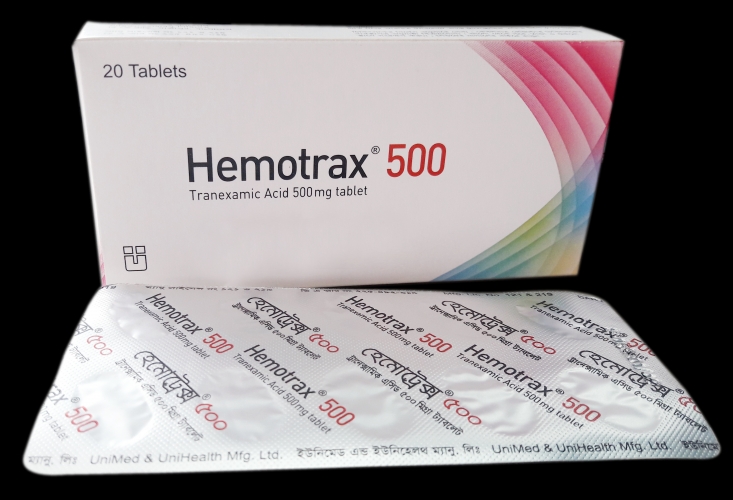 Hemotrax
Presentation
Hemotrax 500mg Tablet: Bluish-white, oblong shaped, film-coated tablet; each tablet contains Tranexamic Acid BP 500mg.
Indication
Hemotrax (Tranexamic Acid) 500mg tablets are indicated for short term use for haemorrhage or risk of haemorrhage in those with increased fibrinolysis or fibrinogenolysis. Local fibrinolysis as occurs in the following conditions:
Prostatectomy and bladder surgery
Menorrhagia
Epistaxis
Conisation of the cervix
Traumatic hyphaema
Management of dental extraction in haemophiliacs
Hereditary angioneuroticoedema
Dosage and administration
Adults: Local Fibrinolysis: The recommended standard dose is 15-25mg/kg body weight i.e. 2-3 Hemotrax (Tranexamic Acid) 500mg tablets two to three times daily. For the indications listed below the following doses may be used:
Prostatectomy: Prophylaxis and treatment of haemorrhage in high risk patients should commence pre or post-operatively with tranexamic acid injection; there after 2 tablets three to four times daily until macroscopic haematuria is no longer present.
Menorrhagia: Recommended dosage is 2 Hemotrax (Tranexamic Acid) 500mg tablets 3 times daily as long as needed for up to 4 days. If very heavy menstrual bleeding, dosage may be increased. A total dose of 8 Hemotrax 500mg (Tranexamic Acid 4gm) tablets daily should not be exceeded. Treatment with Tranexamic Acid should not be initiated until menstrual bleeding has started.
Epistaxis: When repeated bleeding is anticipated oral therapy two Hemotrax (Tranexamic Acid) 500mg tablets three times daily should be administered for 7 days.
Cervix Conisation: Three Hemotrax (Tranexamic Acid) 500mg tablets three times daily.
Traumatic Hyphaema: Two-three Hemotrax (Tranexamic Acid) 500mg tablets 3 times daily. The dose is based on 25mg/kg three times a day.
Haemophilia: In the management of dental extractions two-three Hemotrax (Tranexamic Acid) 500mg tablets every eight hours. The dose is based on 25mg/kg.
Hereditary angioneurotic oedema: Some patients are aware of the onset of illness; suitable treatment for these patients is intermittently two-three Hemotrax (Tranexamic Acid) 500mg tablets two to three times daily for some days. Other patients are treated continuously at this dosage.
Paediatric population: In children, for current approved indications the dosage is in the region of 20mg/kg/day. However, data on efficacy, posology and safety for these indications are limited.
Older patients: No reduction in dosage is necessary unless there is evidence of renal failure.
Renal insufficiency: By extrapolation from clearance data relating to the intravenous dosage form, the following reduction in the oral dosage is recommended for patients with mild to moderate renal insufficiency.
Method of administration: Oral.
Contra-indications, warnings, etc
Contra-indications: Tranexamic Acid tablets in patients with hypersensitivity to the active substance or any of the excipients or active thromboembolic disease or history of venous or arterial thrombosis, fibrinolytic conditions following consumption coagulopathy, severe renal impairment because of risk of accumulation, history of convulsions.
Precautions and warnings: In case of haematuria of renal origin (especially in haemophilia), there is a risk of mechanical anuria due to formation of a ureteral clot. In the long-term treatment of patients with hereditary angioneurotic oedema, regular eye examinations (e.g. visual acuity, slit lamp, intraocular pressure, visual fields) and liver function tests should be performed. Patients with irregular menstrual bleeding should not use Tranexamic Acid until the cause of irregular bleeding has been established. If menstrual bleeding is not adequately reduced by Tranexamic Acid, an alternative treatment should be considered. Tranexamic Acid should be administered with care in patients receiving oral contraceptives because of the increased risk of thrombosis. Patients with a previous thromboembolic event and a family history of thromboembolic disease should use Tranexamic Acid only if there is a strong medical indication and under strict medical supervision. The blood levels are increased in patients with renal insufficiency. Therefore a dose reduction is recommended. The use of Tranexamic Acid in cases of increased fibrinolysis due to disseminated intravascular coagulation is not recommended. Patients who experience visual disturbance should be withdrawn from treatment. Clinical experience with Tranexamic Acid in menorrhagic children under 15 years of age is not available.
Other interactions: Tranexamic Acid will counteract the thrombolytic effect of fibrinolytic preparations.
Use in pregnancy and lactation: There is no evidence from animal studies that Tranexamic Acid has any teratogenic effect, however, the usual caution with use of drugs in pregnancy should be observed. Tranexamic Acid crosses the placenta. Tranexamic Acid passes into breast milk to a concentration of approximately one hundredth of the concentration in the maternal blood. An antifibrinolytic effect in the infant is unlikely.
Side effects: Side effects frequencies are defined as: very common (³ 1/10), common (³ 1/100 to <1/10), uncommon (³ 1/1,000 to <1/100), rare (³ 1/10,000 to <1/1,000), very rare (<1/10,000) and not known. Immune system disorders: Very rare: Hypersensitivity reactions including anaphylaxis. Nervous System Disorders: Very rare: Convulsions, particularly in case of misuse. Eye disorders: Rare: Color vision disturbances, retinal vein/artery occlusion. Vascular disorders: Rare: Thromboembolic events. Very rare: Arterial or venous thrombosis at any sites. Malaise with hypotension, with or without loss of consciousness (generally following a too fast intravenous injection, exceptionally after oral administration). Gastro-intestinal disorders: Very rare: Digestive effects such as nausea, vomiting and diarrhoea, may occur but disappear when the dosage is reduced. Skin and subcutaneous tissue disorders: Rare: Allergic skin reactions.
Overdose: No cases of overdose have been reported. Symptoms may be nausea, vomiting, orthostatic symptoms and hypotension. Initiate vomiting, then stomach lavage, and charcoal therapy. Maintain a high fluid intake to promote renal excretion. There is a risk of thrombosis in predisposed individuals. Anticoagulant treatment should be considered.
Pharmaceutical precautions
Store in a cool and dry place, protected from light.
Packaging quantity
Hemotrax 500mg Tablet: Cartons containing 20 tablets in alu-PVDC blister.
এই পাতাটি ৬৫২ বার দেখা হয়েছে