Search by medicine name. Napa OR Alatrol OR Amodis
Umactin 100mg
TabletNitrofurantoin
Unimed Unihealth MFG. Ltd
Other Strength:
- Umactin 50mg
Alternative:
- Nintoin 100mg
- Nintoin SR 100mg
- Urocure SR 100mg
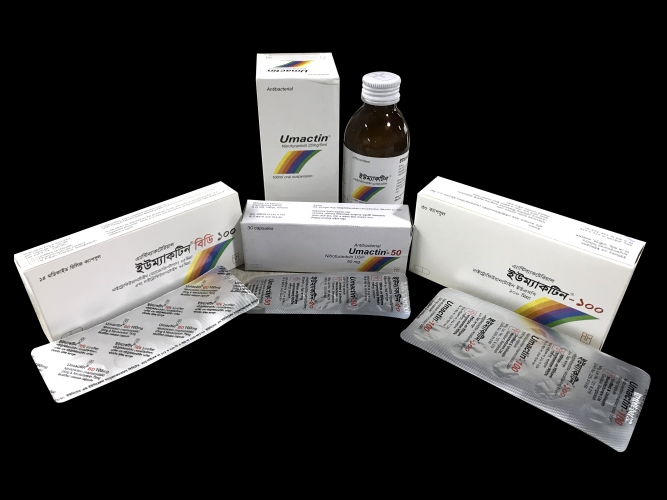
Umactin
Presentation
Umactin-50 capsule: Opaque yellow cap imprinted with “UMC” and opaque white body imprinted with “50” capsule; each capsule contains Nitrofurantoin (as macrocrystal) USP 50mg.
Umactin-100 capsule: Opaque yellow cap imprinted with “UMC” and opaque white body imprinted with “100” capsule; each capsule contains Nitrofurantoin (as macrocrystal) USP 100mg.
Umactin-BD 100 capsule: Opaque blue cap imprinted with “100” and opaque yellow body imprinted with “UMB” capsule; each capsule contains Nitrofurantoin (macrocrystals) USP 25mg and Nitrofurantoin Monohydrate USP equivalent to Nitrofurantoin 75mg.
Umactin oral suspension: Opaque yellow, lemon and blueberry flavoured suspension; each 5ml suspension contains Nitrofurantoin Monohydrate USP equivalent to Nitrofurantoin 25mg.
Indications
For the treatment of and prophylaxis against acute or recurrent, uncomplicated lower urinary tract infections or pyelitis either spontaneous or following surgical procedures.
Nitrofurantoin is specifically indicated for the treatment of infections when due to susceptible strains of Escherichia coli, enterococci, staphylococci, Citrobacter, Klebsiella and Enterobacter.
Dosage and administration
Contra-indications, warnings etc.
Contra-indications: Nitrofurantoin are contra-indicated in patients suffering from renal dysfunction with a creatinine clearance of less than 60 ml/minute or elevated serum creatinine, in infants under 3 months of age as well as pregnant patients at term (during labour and delivery) because of the theoretical possibility of haemolytic anaemia in the foetus or in the newborn infant due to immature erythrocyte enzyme systems and in patients with a known hypersensitivity to nitrofurantoin or other nitrofurans.
Warnings and precautions: Nitrofurantoin is not effective for the treatment of parenchymal infections of unilaterally nonfunctioning kidney. A surgical cause for infection should be excluded in recurrent or severe cases. Since pre-existing conditions may mask adverse reactions, Nitrofurantoin should be used with caution in patients with pulmonary disease, hepatic dysfunction, neurological disorders, and allergic diathesis. Peripheral neuropathy which may become severe or irreversible has occurred and may be life threatening. Therefore, treatment should be stopped at the first signs of neural involvement (paraesthesiae). Nitrofurantoin should be used in caution with patients with anaemia, diabetes mellitus, electrolyte imbalance, debilitating conditions and vitamin B (particularly folate) deficiency. Chronic pulmonary reactions can develop insidiously, and may occur more commonly in elderly patients. Close monitoring of pulmonary conditions of patients receiving long-term therapy is warranted. Nitrofurantoin should be discontinued at any sign of haemolysis in those with suspected glucose-6-phosphate dehydrogenase deficiency. Gastrointestinal reactions may be minimised by taking the drug with food or milk, or by adjustment of dosage.
Use in pregnancy and lactation: Animal studies with Nitrofurantoin have shown no teratogenic effects. Nitrofurantoin has been in extensive clinical use since 1952, and its suitability in human pregnancy has been well documented. The drug should be used at the lowest dose as appropriate for a specific indication, only after careful assessment. Nitrofurantoin is however contra-indicated in infants under 3 months of age and in pregnant women during labour and delivery, because of the possible risk of haemolysis of the infants’ immature red cells. Caution should be exercised while breast feeding an infant known or suspected to have an erythrocyte enzyme deficiency, since Nitrofurantoin is detected in trace amounts in breast milk.
Side effect: Respiratory: If any of the following reactions occur the drug should be discontinued. Acute pulmonary reactions, subacute reactions may take several months to resolve once the drug has been stopped. Chronic pulmonary reactions occur rarely in patients who have received continuous therapy for 6 months or longer and are more common in elderly patients. Changes in ECG have occurred, associated with pulmonary reactions. Minor symptoms such as fever, chills, cough and dyspnoea may be significant. Hepatic: Hepatic reactions including cholestatic jaundice and chronic active hepatitis occur rarely. Treatment should be stopped at the first sign of hepatotoxicity. Neurological: Peripheral neuropathy (including optical neuritis) with symptoms of sensory as well as motor involvement, which may become severe or irreversible, has been reported infrequently. Treatment should be stopped at the first sign of neurological involvement. Gastrointestinal: Nausea and anorexia have been reported. Haematological: Agranulocytosis, leucopenia, granulocytopenia, haemolytic anaemia, thrombocytopenia and megaloblastic anaemia, glucose-6-phosphate dehydrogenase deficiency anaemia, and eosinophilia have been reported. Cessation of therapy has generally returned the blood picture to normal.
Drug interactions:
Increased absorption with food or agents delaying gastric emptying.
Decreased absorption with magnesium trisilicate.
Decreased renal excretion of Nitrofurantoin by probenecid and
sulphinpyrazone.
Decreased anti-bacterial activity by carbonic anhydrase inhibitors and
urine alkalization.
Anti-bacterial antagonism by quinolone anti-infectives.
Interference with some tests for glucose in urine.
Overdose: Symptoms and signs of overdose include gastric irritation, nausea and vomiting. There is no known specific antidote. However, Nitrofurantoin can be haemodialysed in cases of recent ingestion. Standard treatment is by induction of emesis or by gastric lavage. Monitoring of full blood count, liver function, and pulmonary function tests are recommended. A high fluid intake should be maintained to promote urinary excretion of the drug.
Pharmaceutical precautions
Store in a cool and dry place, protected from light.
Packaging quantities
Umactin-50 capsule: Cartons containing 30 capsules in blister.
Umactin-100 capsule: Cartons containing 30 capsules in blister.
Umactin-BD 100 capsule: Cartons containing 14 capsules in blister.
Umactin oral suspension: Glass bottle containing 100ml suspension.
এই পাতাটি ৮৬৯ বার দেখা হয়েছে