ঔষধের বিস্তারিত বা বিকল্প ঔষধ জানতে ঔষধের নাম দিয়ে সার্চ দিন। যেমন- Napa বা Alatrol বা Amodis
Seroquet ER 200mg
TabletQuetiapine Fumarate
Unimed Unihealth MFG. Ltd
Other Strength:
- Seroquet 25mg
- Seroquet 100mg
Alternative:
Seroquet ER
Presentation
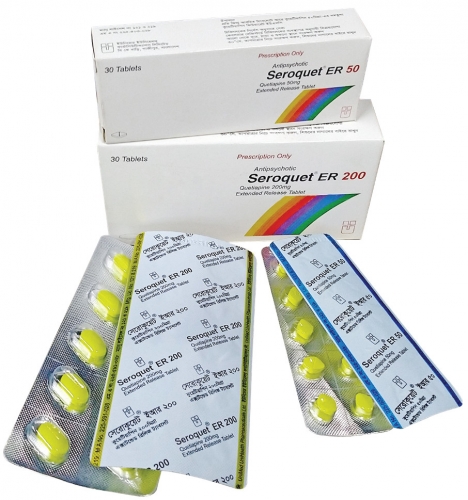
Seroquet® ER 50 tablet: Light yellow, diamond shaped, film-coated extended release tablet; Each tablet contains Quetiapine Fumarate USP equivalent to Quetiapine 50 mg.
Seroquet® ER 200 tablet: Yellow, oval shaped, film-coated extended release tablet; Each tablet contains Quetiapine Fumarate USP equivalent to Quetiapine 200 mg.
Indications
Seroquet® ER (Quetiapine 200mg & 50mg extended release tablet) is indicated for
Treatment of schizophrenia
Treatment of bipolar disorder
For the treatment of moderate to severe manic episodes in bipolar disorder,
For the treatment of major depressive episodes in bipolar disorder,
For the prevention of recurrence of manic or depressed episodes in patients with bipolar disorder who previously responded to Quetiapine treatment.
Dosage & administration
Seroquet® ER (Quetiapine 200 mg & 50 mg extended release tablet) should be administered once daily, without food. The tablets should be swallowed whole and not split, chewed or crushed.
Adults: For the treatment of schizophrenia and moderate to severe manic episodes in bipolar disorder: Seroquet® ER should be administered at least one hour before a meal. The daily dose at the start of therapy is 300 mg on Day 1 and 600 mg on Day 2. The recommended daily dose is 600 mg, however if clinically justified the dose may be increased to 800 mg daily. The dose should be adjusted within the effective dose range of 400 mg to 800 mg per day, depending on the clinical response and tolerability of the patient. For maintenance therapy in schizophrenia no dosage adjustment is necessary.
For the treatment of major depressive episodes in bipolar disorder: Seroquet® ER should be administered at bedtime. The total daily dose for the first four days of therapy is 50 mg (Day 1), 100 mg (Day 2), 200 mg (Day 3) and 300 mg (Day 4). The recommended daily dose is 300 mg. In clinical trials, no additional benefit was seen in the 600 mg group compared to the 300 mg group. Individual patients may benefit from a 600 mg dose. Doses greater than 300 mg should be initiated by physicians experienced in treating bipolar disorder. In individual patients, in the event of tolerance concerns, clinical trials have indicated that dose reduction to a minimum of 200 mg could be considered.
For preventing recurrence in bipolar disorder: For preventing recurrence of manic, mixed or depressive episodes in bipolar disorder, patients who have responded to Seroquet® ER for acute treatment of bipolar disorder should continue on Seroquet® ER at the same dose administered at bedtime. Seroquet® ER dose can be adjusted depending on clinical response and tolerability of the individual patient within the dose range of 300 mg to 800 mg/day. It is important that the lowest effective dose is used for maintenance therapy.
Elderly: as with other antipsychotics and antidepressants, Seroquet® ER should be used with caution in the elderly, especially during the initial dosing period. The rate of dose titration of Seroquet® ER may need to be slower, and the daily therapeutic dose lower, than that used in younger patients. The mean plasma clearance of Quetiapine was reduced by 30% to 50% in elderly patients when compared to younger patients.
Children and adolescents: Seroquet® ER is not recommended for use in children and adolescents below 18 years of age, due to a lack of data to support use in this age group.
Renal impairment: Dosage adjustment is not necessary in patients with renal impairment.
Hepatic impairment: Patient with known hepatic impairment should be started with 25mg/day. The dosage should be increased daily with increments of 25-50mg/day until and effective dosage, depending on the clinical response and tolerability of the individual patient.
Contra-indications, warnings etc.
Contra-indications: Quetiapine is contra-indicated in patients who are hypersensitive to it or any of the excipients of this product.
Special warnings and Precautions for use: As Quetiapine has several indications, the safety profile should be considered with respect to the individual patient’s diagnosis and the dose being administered. Suicide/suicidal thoughts or clinical worsening: Depression in bipolar disorder is associated with an increased risk of suicidal thoughts, self-harm and suicide (suicide-related events). This risk persists until significant remission occurs. As improvement may not occur during the first few weeks or more of treatment, patients should be closely monitored until such improvement occurs. It is general clinical experience that the risk of suicide may increase in the early stages of recovery. Metabolic risk: Given the observed risk for worsening of their metabolic profile, including changes in weight, blood glucose and lipids, which was seen in clinical studies, patient’s metabolic parameters should be assessed at the time of treatment initiation and changes in these parameters should be regularly controlled for during the course of treatment. Worsening in these parameters should be managed as clinically appropriate. Extrapyramidal symptoms: The use of Quetiapine has been associated with the development of akathisia, this is most likely to occur within the first few weeks of treatment. In patients who develop these symptoms, increasing the dose may be detrimental. Tardive dyskinesia: If signs and symptoms of tardive dyskinesia appear, dose reduction or discontinuation of Quetiapine should be considered. The symptoms of tardive dyskinesia can worsen or even arise after discontinuation of treatment. Somnolence and dizziness: Patients experiencing somnolence of severe intensity may require more frequent contact for a minimum of 2 weeks from onset of somnolence, or until symptoms improve and treatment discontinuation may need to be considered. Orthostatic hypotension: Quetiapine
treatment has been associated with orthostatic hypotension and related dizziness which, like somnolence has onset usually during the initial dose-titration period. Quetiapine should be used with caution in patients with known cardiovascular disease, cerebrovascular disease, or other conditions predisposing to hypotension. Dose reduction or more gradual titration should be considered if orthostatic hypotension occurs, especially in patients with underlying cardiovascular disease. Sleep apnoea syndrome: In patients receiving concomitant central nervous system depressants and who have a history of or are at risk for sleep apnoea, such as those who are overweight/obese or are male, Quetiapine should be used with caution. Seizures: As with other antipsychotics, caution is recommended when treating patients with a history of seizures. Neuroleptic malignant syndrome: In such an event, Quetiapine should be discontinued and appropriate medical treatment given. Anti-cholinergic (muscarinic) effects: Nor Quetiapine, an active metabolite of Quetiapine, has moderate to strong affinity for several muscarinic receptor subtypes. Quetiapine should be used with caution in patients with a current diagnosis or prior history of urinary retention, clinically significant prostatic hypertrophy, intestinal obstruction or related conditions, increased intraocular pressure or narrow angle glaucoma. Interactions: Concomitant use of Quetiapine with a strong hepatic enzyme inducer such as carbamazepine or phenytoin substantially decreases Quetiapine plasma concentrations, which could affect the efficacy of Quetiapine therapy. It is important that any change in the inducer is gradual, and if required, replaced with a non-inducer (e.g.
sodium valproate). Weight: Weight gain has been reported in patients who have been treated with Quetiapine, and should be monitored and managed as clinically appropriate as in accordance with utilised antipsychotic guidelines. Hyperglycaemia: Patients treated with any antipsychotic agent including Quetiapine, should be observed for signs and symptoms of hyperglycaemia, (such as polydipsia, polyuria, polyphagia and weakness) and patients with diabetes mellitus or with risk factors for diabetes mellitus should be monitored regularly for worsening of glucose control. Weight should be monitored regularly. Lipids: Increases in triglycerides, LDL and total cholesterol, and decreases in HDL cholesterol have been observed in clinical trials with Quetiapine. Lipid changes should be managed as clinically appropriate. Cardiomyopathy and myocarditis: Treatment with Quetiapine should be reassessed in patients with suspected cardiomyopathy or myocarditis. Withdrawal: Acute withdrawal symptoms such as insomnia, nausea, headache, diarrhoea, vomiting, dizziness, and irritability have been described after abrupt cessation of Quetiapine. Gradual withdrawal over a period of at least one to two weeks is advisable. Elderly patients with dementia-related psychosis: Quetiapine is not approved for the treatment of dementia-related psychosis. QT prolongation: In post-marketing, QT prolongation was reported with Quetiapine at the therapeutic doses and in overdose. As with other antipsychotics, caution should be exercised when Quetiapine is prescribed in patients with cardiovascular disease or family history of QT prolongation. Also, caution should be exercised when Quetiapine is prescribed either with medicines known to increase QT interval, or with concomitant neuroleptics, especially in the elderly, in patients
with congenital long QT syndrome, congestive heart failure, heart hypertrophy, hypokalaemia or hypomagnesaemia. Dysphagia: Dysphagia has been reported with Quetiapine. Quetiapine should be used with caution in patients at risk for aspiration pneumonia. Constipation and intestinal obstruction: Constipation represents a risk factor for intestinal obstruction. Patients with intestinal obstruction should be managed with close monitoring and urgent care. Venous thromboembolism: Cases of venous thromboembolism have been reported with antipsychotic drugs. Since patients treated with antipsychotics often present with acquired risk factors for VTE, all possible risk factors for VTE should be identified before and during treatment with Quetiapine and preventive measures undertaken. Pancreatitis: Pancreatitis has been reported in clinical trials and during post marketing experience. Among post marketing reports, while not all cases were confounded by risk factors, many patients had factors which are known to be associated with pancreatitis such as increased triglycerides, gallstones and alcohol consumption. Lactose: Quetiapine tablets contain lactose. Patients with rare hereditary problems of galactose intolerance, the Lapp lactase deficiency, or glucose-galactose malabsorption should not take this medicine.
Use in pregnancy & lactation: The safety and efficacy of Quetiapine during human pregnancy have not been established. Therefore, Quetiapine should only be used during pregnancy if the benefits justify the potential risks and the administered dose and duration of treatment should be as low and as short as possible. The degree to which Quetiapine is excreted into human milk is unknown. Women who are breast-feeding should therefore be advised to avoid breast-feeding while taking Quetiapine.
Drug interactions: Caution should be exercised when Quetiapine is used concomitantly with medicines known to cause electrolyte imbalance or to increase QT interval. Co-administration of Quetiapine and thioridazine or carbamazepine caused increases in the clearance of Quetiapine. Co-administration of Quetiapine with another microsomal enzyme inducer, phenytoin, also caused increases in the clearance of Quetiapine.
Side effects: The most commonly reported Adverse Drug Reactions (ADRs) with Quetiapine are somnolence, dizziness, dry mouth, withdrawal (discontinuation) symptoms, elevations in serum triglyceride levels, elevations in total cholesterol (predominantly LDL cholesterol), decreases in HDL cholesterol, weight gain, decreased hemoglobin and extrapyramidal symptoms.
Overdose: In clinical trials, survival has been reported in acute overdoses of up to 30 grams of Quetiapine. There is no specific antidote to Quetiapine. In cases of severe intoxication, the possibility of multiple drug involvement should be considered, and intensive care procedures are recommended, including establishing and maintaining a patent airway, ensuring adequate oxygenation and ventilation, and monitoring and support of the cardiovascular system. In cases of Quetiapine overdose, refractory hypotension should be treated with appropriate measures such as intravenous fluids and/or sympathomimetic agents (adrenaline and dopamine should be avoided, since beta stimulation may worsen hypotension in the setting of Quetiapine-induced alpha blockade). Close medical supervision and monitoring should be continued until the patient recovers.
Pharmaceutical precautions
Store in a cool and dry place, protected from light.
Store below 30°C
Packaging quantities
Seroquet® ER 50 tablet: Carton containing 30 tablets in Alu-PVDC blister.
Seroquet® ER 200 tablet: Carton containing 30 tablets in Alu-PVDC blister.
এই পাতাটি ৪২৯ বার দেখা হয়েছে