Search by medicine name. Napa OR Alatrol OR Amodis
Selomet-SR 50mg
TabletMetoprolol Tartrate
Unimed Unihealth MFG. Ltd
Other Strength:
Alternative:
- Presonil 50mg
- Betacard 50mg
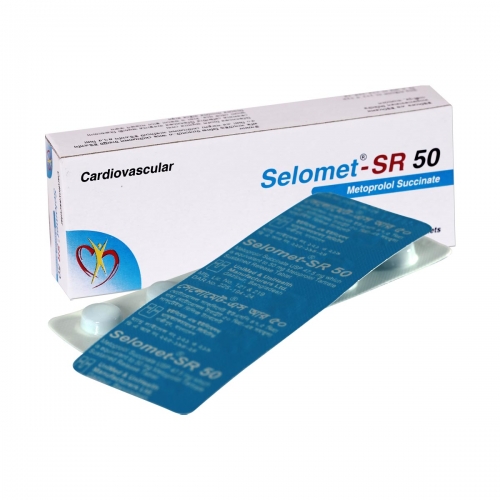
Selomet-SR
Presentation
Selomet-SR 50 tablet: Blue, barrel shaped, film coated tablet; each tablet contains USP 47.5 mg Metoprolol Succinate equivalent to Metoprolol Tartrate USP 50 mg.
Indications
Hypertension : Sustained release Metoprolol Succinate tablet is indicated for the treatment of hypertension. It may be used alone or in combination with other antihypertensive agents.
Angina Pectoris : Sustained release Metoprolol Succinate tablet is indicated in the longterm treatment of angina pectoris.
Heart Failure : Sustained release Metoprolol Succinate is indicated for the treatment of stable, symptomatic (NYHA Class II of III) heart failure of ischemic hypertensive, or cardiomyopathic origin.
Dosage and administration:
Hypertension : The usual initial dosage is 25 to 100 mg daily in a single dose, whether used alone or added to a diuretic.
Angina Pectoris: The dosage of extended release Metoprolol Succinate should be individualized. The usual initial dosage is 100 mg daily, in a single dose.
Heart Failure : The recommended starting dose of sustained release Metoprolol Succinate is 25 mg once daily for two weeks in patients with NYHA class II heart failure and 12.5 mg once daily in patients with more severe heart failure. The dosage may be increased at weekly (or longer) intervals until optimum blood pressure reduction is achieved. If treatment is to be discontinued, the dosage should be reduced gradually over a period of 1-2 weeks.
Contra-indications, warnings, etc.
Contra-indications: AV block, Uncontrolled heart failure, severe bradycardia, sick”sinus syndrome, cardiogenic shock and severe peripheral arterial disease. Known hypersensitivity to Metoprolol or other [5-blockers. Metoprolol is also contra-indicated when myocardial infarction is complicated by significant bradycardia, first degree heart block, systolic hypotension (<100mmHg) and/or severe heart failure.
Warnings: Metoprolol may aggravate bradycardia, symptoms of peripheral arterial circulatory disorders and anaphylactic shock. Abrupt interruption of B-blockers is to be avoided. When possible, Metoprolol should be withdrawn gradually over a period of 10 days, in diminishing doses to 25 mg daily for the last 6 days. During its withdrawal patients should be kept under close surveillance, especially those with known ischaemic heart disease. Metoprolol may be administered when heart failure has been controlled. Digitalisation and/or diuretic therapy should also be considered for patients with a history of heart failure, or patients known to have a poor cardiac reserve. Although cardioselective B-blockers may have less effect on lung function than non-selective [5- blockers, as with all B-blockers these should be avoided in patients with reversible obstructive airways disease unless there are compelling clinical reasons for their use. When administration is necessary, use of a [52-bronchodilator (e.g. terbutaline) may be advisable in some patients. In Iabile and insulin-dependent diabetes it may be necessary to adjust the hypoglycaemic therapy. In patients with a phaeochromocytoma, an orblocker should be given concomitantly. In the presence of liver cirrhosis the bioavailability of Metoprolol may be increased. The administration of adrenaline to patients undergoing [5-blockade can result in an increase in blood pressure and bradycardia, although this is less likely to occur with B1 -selective drugs. Metoprolol therapy must be reported to the anaesthetist prior to general anaesthesia. If withdrawal of Metoprolol is considered desirable, this should if possible be completed at least 48 hours before general anaesthesia. However, in some patients it may be desirable to employ a B-blocker as premedication. By shielding the heart against the effects of stress the [5-blocker may prevent excessive sympathetic stimulation provoking cardiac arrhythmias or acute coronary insufficiency. If a B-blocker is given for this purpose, an anaesthetic with little negative inotropic activity should be selected to minimise the risk of myocardial depression.
Use in pregnancy and lactation: Metoprolol should not be used in pregnancy or lactating mothers unless the physician considers that the benefit outweighs the possible hazard to the foetus/infant.
Drug interactions: The effects of Metoprolol and other antihypertensive drugs on blood pressure are usually additive, and care should be taken to avoid hypotension. However, combinations of antihypertensive drugs may often be used with benefit to improve control of hypertension. Metoprolol can reduce myocardial contractility and impair intracardiac conduction. Care should be exercised when drugs with similar activity, e.g. antiarrhythmic agents, general anaesthetics, are given concurrently. Like all other [3-blockers, Metoprolol should not be given in combination with verapamil since this may cause bradycardia, hypotension and asystole. Care should also be exercised when [5-blockers are given in combination with sympathetic ganglion blocking agents, other [3-blockers (i.e. eye drops) or MAO inhibitors. If combination treatment with clonidine is to be discontinued, Metoprolol should be withdrawn several days before clonidine. As Bblockers may affect the peripheral circulation, care should be exercised when drugs with similar activity e.g. ergommine are given concurrently. Metoprolol will antagonise the B1- effects of sympathomimetic agents but should have little influence on the bronchodilator effects of [32-agonists at normal therapeutic doses. Enzyme inducing agents (e.g. rifampicin) may reduce plasma concentrations of Metoprolol, whereas enzyme inhibitors (e.g.cimetidine) may increase plasma concentrations. Metoprolol may impair the elimination of lignocaine. Indomethacin may reduce the antihypertensive effect of Bblockers.
Side-effects: These are usually mild and infrequent. The most common appear to be lassitude, GI disturbances (nausea, vomiting or abdominal pain) and disturbances of sleep pattern. In many cases these effects have been transient or have disappeared after a reduction in dosage. Effects related to the CNS which have been reported occasionally are dizziness and headache and rarely paraesthesia, muscle cramps, depression and decreased mental alertness. There have also been isolated reports of personality disorders. Cardiovasculareffects which have been reported occasionally are bradycardia, postural hypotension and rarely, heart failure, palpitation, cardiac arrhythmias, Ftaynauds phenomenon, peripheral oedema and preoordial pain, There have also been isolated reports of cardiac conduction abnormalities and gangrene in patients with pre-existing severe peripheral circulatory disorders. Common gastro-intestinal disturbances have been described above but rarely diarrhoea or constipation also occur and there have been isolated cases of dry mouth and abnormal liver function. Skin rashes (urticaria, psoriasiform, dystrophic skin lesions) and positive anti-nuclear antibodies (not associated with SLE) occur rarely, Isolated cases of photosensitivity, increased sweating and alopecia have been reported. Respiratory effects include occasional reports of dyspnoea on exertion and rare reports of bronchospasm and isolated cases of rhinitis. Isolated cases of weight gain, thrombocytopenia, disturbances of vision, coniunctivitis, tinnitus and dry or irritated eyes have also been reported. The reported incidence of skin rashes and/or dry eyes is small and in most cases the symptoms have cleared when treatment was withdrawn. Discontinuation of the drug should be considered if any such reaction is not otherwise explicable.
Overdosage: Poisoning due to an overdose of metoprolol may lead to severe hypotension, sinus bradycardia, atrioventricular block, heart failure, cardiogenic shock, cardiac arrest, bronchospasm, impairment of consciousness, coma, nausea, vomiting, cyanosis, hypoglycaemia and, occasionally, hyperkalaemia. The first manifestations usually appear 20 minutes to 2 hours after drug ingestion, Treatment: Treatment should include close monitoring of cardiovascular, respiratory and renal function, and blood glucose and electrolytes. Further absorption may be prevented by induction of vomiting, gastric lavage or administration of activated-charcoal if ingestion is recent. Cardiovascular complications should be treated symptomatically, which may require the use of sympathomimetic agents (e.g. noradrenaline, metaramionl), atropine or inotropic agents (e.g. dopamine, dobutamine). Temporary pacing may be required for AV block. Glucagon can reverse the effects of excessive B-blockade, given in a dose of 1-10 mg intravenously. Intravenous B2-stimulants e.g. terbutaline may be required to relieve bronchospasm. Metoprolol cannot be effectively removed by haemodialysis.
Pharmaceutical precautions
Store in a cool and dry place, protected from light.
Packaging quantities
Selomet-SR 50 tablet: Each carton containing 30 tablets in Alu – PVDC blister.
এই পাতাটি ৪৪০ বার দেখা হয়েছে