ঔষধের বিস্তারিত বা বিকল্প ঔষধ জানতে ঔষধের নাম দিয়ে সার্চ দিন। যেমন- Napa বা Alatrol বা Amodis
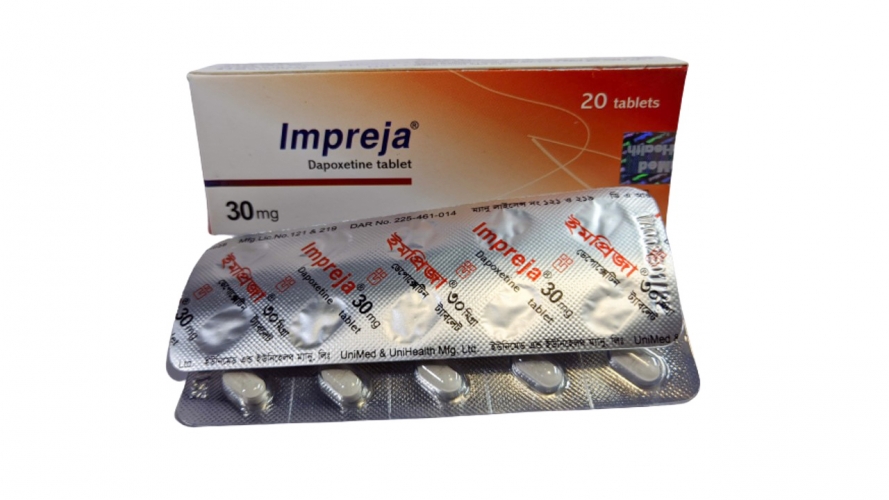
Impreja 30mg
Tablet
Dapoxetine Hydrochloride Unimed Unihealth MFG. Ltd
Other Strength:
Alternative:
- Maturex 30mg
- Susten 30mg
- Daxetin 30mg
- Prolong 30mg
 Impreja
Presentation
Impreja 30 tablet: Gray, capsule shaped, scored on one side, engraved on other side, film coated tablet; each tablet contains Dapoxetine Hydrochloride INN equivalent to Dapoxetine 30mg.
Indications
Impreja (Dapoxetine) is indicated for the treatment of premature ejaculation (PE) in adult men aged 18 to 64 years. Impreja (Dapoxetine) should only be prescribed to patients who meet all the following criteria:
An intravaginal ejaculatory latency time (IELT) of less than two minutes; and
Persistent or recurrent ejaculation with minimal sexual stimulation before on or
shortly after penetration and before the patient wishes; and
Marked personal distress or interpersonal difficulty as a consequence of premature
ejaculation (PE); and
Poor control over ejaculation; and
A history of premature ejaculation in the majority of intercourse attempts over the
prior 6 months.
Impreja (Dapoxetine) should be administered only as on-demand treatment before
anticipated sexual activity. Impreja (Dapoxetine) should not be prescribed to delay
ejaculation in men who have not been diagnosed with premature ejaculation (PE).
Dosage and administration
Adult men (aged 18 to 64 years): The recommended starting dose for all patients is 30mg (one Impreja 30 tablet), taken as needed approximately 1 to 3 hours prior to sexual activity. Treatment with Impreja (Dapoxetine) should not be initiated with the 60mg (two Impreja 30 tablets) dose. Impreja (Dapoxetine) is not intended for continuous daily use. Impreja (Dapoxetine) should be taken only when sexual activity is anticipated. Impreja (Dapoxetine) must not be taken more frequently than once every 24 hours. If the individual response to 30mg(one Impreja 30 tablet) is insufficient and the patient has not experienced moderate or severe adverse reactions or prodromal symptoms suggestive of syncope, the dose may be increased to a maximum recommended dose of 60mg (two Impreja 30 tablets) taken as needed approximately 1 to 3 hours prior to sexual activity. The incidence and severity of adverse events is higher with the 60mg dose. If the patient experienced orthostatic reactions on the starting dose, no dose escalation to 60mg should be performed. A careful appraisal of individual benefit risk of Impreja (Dapoxetine) should be performed by the physician after the first four weeks of treatment (or at least after 6 doses of treatment) to determine whether continuing treatment with Dapoxetine is appropriate. Data regarding the efficacy and safety of Dapoxetine beyond 24 weeks are limited. The clinical need of continuing and the benefit risk balance of treatment with Dapoxetine should be re-evaluated at least every six months.
Elderly (age 65 years and over): The efficacy and safety of Dapoxetine have not been established in patients age 65 years and over.
Paediatric population: There is no relevant use of Dapoxetine in this population in the indication of premature ejaculation.
Patients with renal impairment: Caution is advised in patients with mild or moderate renal impairment. Dapoxetine is not recommended for use in patients with severe renal impairment.
Patients with hepatic impairment: Dapoxetine is contra-indicated in patients with moderate and severe hepatic impairment (Child-Pugh Class B and C).
Known CYP2D6 poor metabolizers or patients treated with potent CYP2D6 inhibitors: Caution is advised if increasing the dose to 60mg in patients known to be of CYP2D6 poor metabolizer genotype or in patients concomitantly treated with potent CYP2D6 inhibitors.
Patients treated with moderate or potent inhibitors of CYP3A4: Concomitant use of potent CYP3A4 inhibitors is contra-indicated. The dose should be restricted to 30mg in patients concomitantly treated with moderate CYP3A4 inhibitors and caution is advised.
Contra-indications, warnings, etc
Contra-indications: Dapoxetine tablet is contra-indicated in patients with known hypersensitivity to Dapoxetine. Significant pathological cardiac conditions such as: Heart failure (NYHA class II-IV), conduction abnormalities such as AV block or sick sinus syndrome, significant ischemic heart disease, significant valvular disease, a history of syncope, a history of mania or severe depression. Concomitant treatment with monoamine oxidase inhibitors (MAOIs), or within 14 days of discontinuing treatment with an MAOI. Similarly, an MAOI should not be administered within 7 days after Dapoxetine has been discontinued. Concomitant treatment with thioridazine, or within 14 days of discontinuing treatment with thioridazine. Similarly, thioridazine should not be administered within 7 days after Dapoxetine has been discontinued. Concomitant treatment with serotonin reuptake inhibitors [selective serotonin reuptake inhibitors (SSRIs), serotonin-norepinephrine reuptake inhibitors (SNRIs), tricyclic antidepressants (TCAs)] or other medicinal/herbal products with serotonergic effects [e.g., L-tryptophan, triptans, tramadol, linezolid, lithium, St. John’s Wort (Hypericum perforatum)] or within 14 days of discontinuing treatment with these medicinal/herbal products. Similarly, these medicinal/herbal products should not be administered within 7 days after Dapoxetine has been discontinued. Concomitant treatment of potent CYP3A4 inhibitors such as ketoconazole, itraconazole, ritonavir, saquinavir, telithromycin, nefazadone, nelfinavir, atazanavir, etc.
Precautions and warnings: General recommendations: Dapoxetine is only indicated in men with Premature Ejaculation. Dapoxetine should not be prescribed to men who have not been diagnosed with Premature Ejaculation. Safety has not been established and there are no data on the ejaculation-delaying effects in men without Premature Ejaculation. Other forms of sexual dysfunction: Before treatment, subjects with other forms of sexual dysfunction, including erectile dysfunction, should be carefully investigated by physicians. Dapoxetine should not be used in men with erectile dysfunction (ED) who are using PDE5 inhibitors. Orthostatic hypotension: Before treatment initiation, a careful medical examination including history of orthostatic events should be performed by the physician. An orthostatic test should be performed before initiating therapy (blood pressure and pulse rate, supine and standing). In case of a history of documented or suspected orthostatic reaction, treatment with Dapoxetine should be avoided. Orthortatic hypotension has been reported in clinical trial. Patients with cardiovascular risk factors: Subjects with underlying cardiovascular disease were excluded from Phase 3 clinical trials. The risk of adverse cardiovascular outcomes from syncope (cardiac syncope and syncope from other causes) is increased in patients with underlying structural cardiovascular disease (e.g., documented outflow obstruction, valvular heart disease, carotid stenosis and coronary artery disease). There are insufficient data to determine whether this increased risk extends to vasovagal syncope in patients with underlying cardiovascular disease. Use with recreational drugs: Patients should be advisednot to use Dapoxetine in combination with recreational drugs. Recreational drugs with serotonergic activity such as ketamine, methylenedioxymethamphetamine (MDMA) and lysergic acid diethylamide (LSD) may lead to potentially serious reactions if combined with Dapoxetine. These reactions include, but are not limited to, arrhythmia, hyperthermia, and serotonin syndrome. Use of Dapoxetine with recreational drugs with sedative properties such as narcotics and benzodiazepines may further increase somnolence and dizziness. Renal impairment: Dapoxetine is not recommended for use in patients with severe renal impairment and caution is advised in patients with mild or moderate renal impairment. Withdrawal effects: Abrupt discontinuation of chronically administered SSRIs used to treat chronic depressive disorders has been reported to result in the following symptoms: dysphoric mood, irritability, agitation, dizziness, sensory disturbances (e.g., paresthesias such as electric shock sensations), anxiety, confusion, headache, lethargy, emotional lability, insomnia and hypomania.
Drug interactions: Pharmacodynamic interactions: Potential for interaction with monoamine oxidase inhibitors: In patients receiving an SSRI in combination with a monoamine oxidase inhibitor (MAOI), there have been reports of serious, sometimes fatal, reactions including hyperthermia, rigidity, myoclonus, autonomic instability with possible rapid fluctuations of vital signs, and mental status changes that include extreme agitation progressing to delirium and coma. These reactions have also been reported in patients who have recently discontinued an SSRI and have been started on an MAOI. Pharmacokinetic interactions: Effects of co-administered medicinal products on the pharmacokinetics of dapoxetine: In vitro studies in human liver, kidney, and intestinal microsomes indicate dapoxetine is metabolized primarily by CYP2D6, CYP3A4 and flavin monooxygenase 1 (FMO1). Therefore, inhibitors of these enzymes may reduce dapoxetine clearance. CYP3A4 inhibitors: Potent CYP3A4 inhibitors. Administration of ketoconazole (200mg twice daily for 7 days) increased the Cmax and AUCinf of dapoxetine (60mg single dose) by 35% and 99%, respectively. Therefore, concomitant use of Dapoxetine and potent CYP3A4 inhibitors, such as ketoconazole, itraconazole, ritonavir, saquinavir, telithromycin, nefazodone, nelfinavir and atazanavir, is contraindicated. Moderate CYP3A4 inhibitors: Concomitant treatment with moderate CYP3A4 inhibitors (e.g., erythromycin, clarithromycin, fluconazole, amprenavir, fosamprenavir, aprepitant, verapamil, diltiazem) may also give rise to significantly increased exposure of dapoxetine and desmethyldapoxetine, especially in CYP2D6 poor metabolizers. The maximum dose of dapoxetine should be 30 mg if dapoxetine is combined with any of these drugs. PDE5 inhibitors: Dapoxetine should not be used in patients using PDE5 inhibitors due to possible reduced orthostatic tolerance. The pharmacokinetics of dapoxetine (60mg) in combination with tadalafil (20mg) and sildenafil (100mg) were evaluated in a single dose crossover study. Tadalafil did not affect the pharmacokinetics of dapoxetine. Sildenafil caused slight changes in dapoxetine pharmacokinetics (22% increase in AUCinf and 4% increase in Cmax), which are not expected to be clinically significant. Concomitant use of Dapoxetine with PDE5 inhibitors may result in orthostatic hypotension. Effects of dapoxetine on the pharmacokinetics of co-administered medicinal products: Tamsulosin: Concomitant administration of single or multiple doses of 30mg or 60mg dapoxetine to patients receiving daily doses of tamsulosin did not result in changes in the pharmacokinetics of tamsulosin.
Use in pregnancy and lactation: Dapoxetine is not indicated for use by women. Animal studies do not indicate direct or indirect harmful effects with respect to fertility, pregnancy or embryonal/foetal development. It is not known if either dapoxetine or its metabolites are excreted in human milk.
Side effect: Summary of the safety profile: Syncope and orthostatic hypotension have been reported in clinical trials. The following adverse drug reactions were reported during Phase 3 clinical trials most commonly and were dose related: nausea (11.0% and 22.2% in 30mg and 60mg prn dapoxetine groups, respectively), dizziness (5.8% and 10.9%), headache (5.6% and 8.8%), diarrhoea (3.5% and 6.9%), insomnia (2.1% and 3.9%) and fatigue (2.0% and 4.1%). The most common adverse events leading to discontinuation were nausea (2.2% of Dapoxetine-treated subjects) and dizziness (1.2% of Dapoxetine-treated subjects).
Tabulated list of adverse reactions
…………………….
Overdose: No case of overdose has been reported. There were no unexpected adverse events in a clinical pharmacology study of Dapoxetine with daily doses up to 240mg (two 120mg doses given 3 hours apart). In general, symptoms of overdose with SSRIs include serotonin-mediated adverse reactions such as somnolence, gastrointestinal disturbances such as nausea and vomiting, tachycardia, tremor, agitation and dizziness. In cases of overdose, standard supportive measures should be adopted as required. Due to high protein binding and large volume of distribution of dapoxetine hydrochloride, forced diuresis, dialysis, hemoperfusion and exchange transfusion are unlikely to be of benefit. No specific antidotes for Dapoxetine are known.
এই পাতাটি ৮৪৫ বার দেখা হয়েছে