Search by medicine name. Napa OR Alatrol OR Amodis
Imnoc 25mg
TabletImipramine
Unimed Unihealth MFG. Ltd
Other Strength:
Alternative:
- Pramin 25mg
- Depram® 25mg
- Pinor 25mg
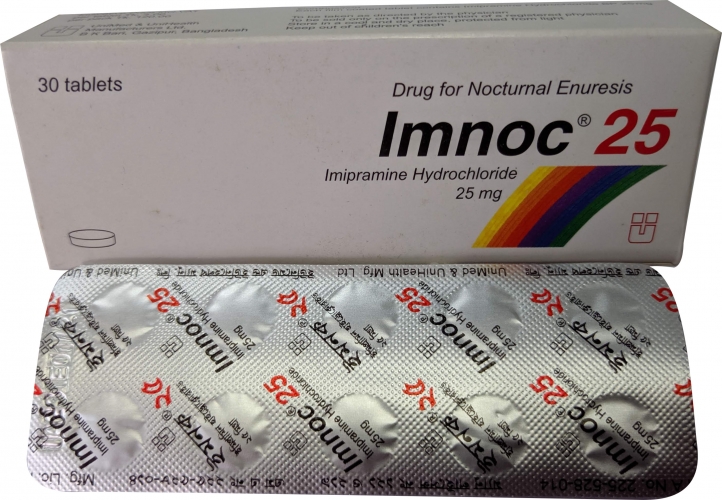
Imnoc
Presentation
Imnoc 25mg tablet: Red, round shaped, film coated tablet; each film coated tablet contains Imipramine Hydrochloride BP 25mg.
Indications
Imnoc (Imipramine Hydrochloride) 25mg tablet is indicated for the relief of nocturnal enuresis in children.
Dosage and administration
Nocturnal Enuresis in Children: Not for use in children under 6 years. The daily dose should not be exceeded 75mg in children. The dose should be taken just before bedtime.
6 – 7 years (weight 20-25kg) : 25mg (1 Imnoc 25 tablet) daily
8 – 11 years (weight 25-35kg) : 25-50mg (1-2 Imnoc 25 tablet) daily
Over 11 years (weight 35-54kg) : 50-75mg (2-3 Imnoc 25 tablets) daily
The maximum period of treatment should not exceed three months and withdrawal should be gradual. If relapse occur, a further course of treatment should not be started until a full physical examination has been made.
Contra-indications, warnings, etc.
Contra-indications: Imipramine is contra-indicated in cases of hypersensitivity to Imipramine, recent myocardial infarction, any degree of heart block or other cardiac arrhythmias, mania, severe liver disease, narrow angle glaucoma, infants and children under 6 years old, retention of urine, concurrent use in patients receiving, or within 3 weeks of cessation of therapy with monoamine oxidase inhibitors, concomitant treatment with selective, reversible MAO-A inhibitors such as moclobemide and porphyria.
Warnings & Precautions: Hyponatraemia (usually in the elderly) has been associated with all types of antidepressants and should be considered in all patients who develop symptoms such as drowsiness, confusion or convulsions. Tricyclic antidepressants are known to lower the convulsion threshold, Imipramine should be used with extreme caution in patients with epilepsy and other predisposing factors, e.g. brain damage of varying aetiology, concomitant use of neuroleptics, withdrawal from alcohol or drugs with anticonvulsive properties (e.g. benzodiazepines). Concomitant treatment of Imipramine and electroconvulsive therapy should only be resorted to under careful supervision. Caution is required for when giving tricyclic antidepressants to patients with severe renal disease. Caution is required for when giving tricyclic antidepressants to patients with tumors of the adrenal medulla (e.g. phaeochromocytoma, neuroblastoma), in whom they may provoke hypertensive crises. Many patients with panic disorders experience intensified anxiety symptoms at the start of the treatment with antidepressants. Caution is indicated in patients with hyperthyroidism or during concomitant treatment with thyroid preparations since aggravation of unwanted cardiac effects may occur. Before initiating treatment, it is advisable to check the patient’s blood pressure, because individuals with hypotension or a labile circulation may react to the drug with a fall in blood pressure. Although changes in the white blood cell count have been reported with Imipramine only in isolated cases, periodic blood cell counts and monitoring for symptoms such as fever and sore throat are called for, particularly during the first few months of therapy. Periodic monitoring of hepatic enzymes levels is recommended in patients with liver disease. In elderly patients monitoring of cardiac function is indicated. Because of its anticholinergic properties, Imipramine should be used with caution in patients with a history of increased intra-ocular pressure, narrow angle glaucoma, or urinary retention (e.g. diseases of the prostate). Caution is called for in patients with chronic constipation. Before general or local anaesthesia, the anaesthetist should be aware that the patient has been receiving Imipramine Hydrochloride.
Drug Interactions: MAO inhibitors: Imipramine Hydrochloride should not be used for at least 3 weeks after discontinuation of treatment with MAO inhibitors. The same applies when giving a MAO inhibitor after previous treatment with Imipramine Hydrochloride. In both instances Imipramine Hydrochloride or the MAO inhibitors should initially be given in small, gradually increasing doses and its effects monitored. Selective serotonin reuptake inhibitors (SSRIs): Co-medication may lead to additive effects on the serotonergic system. Fluvoxetine and fluvoxamine may also increase plasma concentrations of Imipramine may the lowered convulsion threshold and seizures. CNS depressants: Tricyclic antidepressants may also increase the effects of alcohol and central depressant drugs (e.g. barbiturates, benzodiazepines or general anaesthetics). Alprazolam and disulfiram: It may be necessary to reduce the dosage of Imipramine if it is administered concomitantly with aprazolam or disulfiram. Neuroleptics: Co-medication may result in increased plasma levels of tricyclic antidepressants, a lowered convulsion threshold and seizures. Combination with thioridazine may produce severe cardiac arrhythmias. Beta-blockers: Blood concentrations of Imipramine may be increased by drugs such as labetalol and propranolol. The clinical importance of these interactions is uncertain. Diuretics: Concurrent use of a tricyclic and a diuretic may increase the risk of postural hypotension. Alpha2-adrenoceptor stimulants: Concomitant use of apraclonidine or brimonidine should be avoided. Anticoagulants: Tricyclic antidepressants may potentiate the anti-coagulant effect of coumarin drugs by inhibiting hepatic metabolism of these anticoagulants. Careful monitoring of plasma prothrombin is therefore advised. Anticholinergic agents: Tricyclic antidepressants may potentiate the effects of these drugs on the eye, central nervous system, bowel and bladder. Sympathomimetic drugs: Imipramine may potentiate the cardiovascular effects of adrenaline (epinephrine), ephedrine, isoprenaline, noradrenaline (norepinephrine), phenylephrine and phenylpropanolamine. Quinidine: Tricyclic antidepressants should not be employed in combination with antiarrhythmic agents of the quinidine type. Liver enzyme inducers: Drugs that activate the hepatic mono-oxygenase enzyme system (e.g. barbiturates, carbamazepine, phenytoin, nicotine, and oral contraceptives) may accelerate the metabolism and lower plasma concentrations of Imipramine, resulting in decreased efficacy. Cimetidine, methylphenidate, terbinafine, amfebutamone: These drugs may increase the plasma concentrations of tricyclic antidepressants, whose dosage should therefore be reduced. Oestrogens: There is evidence that oestrogens can sometimes paradoxically reduce the effects of Imipramine yet at the same time cause Imipramine toxicity. Antiviral agents: Drugs such as ritonavir have been reported to increase plasma concentrations of antidepressant drugs. Calcium channel blockers: Blood levels of Imipramine may be increased by calcium channel blockers such as diltiazem and verapamil. Nitrates: Reduced salivary secretion may lessen the effectiveness of sub-lingual nitrate preparations. Antineoplastic drugs: Concomitant use of altretamine should be avoided due to the risk of severe postural hypotension.
Use in pregnancy & lactation: Pregnancy: There is no evidence of the safety of the drug in human pregnancy. Treatment with Imipramine Hydrochloride should be avoided during pregnancy. Lactation: The active substance of Imipramine Hydrochloride, Imipramine, and its metabolites, desmethylImipramine, pass into the breast milk in small quantities. Imipramine Hydrochloride should be gradually withdrawn or the mother advised to cease breast-feeding.
Side-effects: If severe neurological or psychiatric reactions occur, Imipramine Hydrochloride should be withdrawn. The following side effects, although not necessarily observed with Imipramine, have occurred with tricyclic antidepressants. Central Nervous System: Psychiatric Effects: Occasionally: fatigue, drowsiness, restlessness, delirium, confusion, disorientation and hallucination (particularly in geriatric patients and those suffering from Parkinson’s disease) increased anxiety, agitation, sleep disturbances, swings from depression to hypomania or mania. Rarely: activation of psychotic symptoms. Isolated cases: aggressiveness. Neurological Effects: Frequently: tremor. Occasionally: paraesthesia, headache, dizziness. Rarely: epileptic seizures. Isolated cases: EEG changes, myoclonus, weakness, extrapyramidal symptoms, ataxia, speech disorder, drug fever. Cardiovascular System: Frequently: sinus tachycardia and clinically irrelevant ECG changes (T and ST changes) in patients of normal cardiac status, postural hypotension are likely to occur with high dosage or in deliberate overdosage. Occasionally: arrhythmias, conduction disorders, palpitations. Isolated cases: increased blood pressure, cardiac decompensation, peripheral vasospastic reactions. Anticholinergic Effects: Frequently: dry mouth, sweating, constipation, blurred vision, hot flushes. Occasionally: disturbances of micturition. Isolated cases: mydriasis, glaucoma, paralytic ileus. Gastro-Intestinal Tract: Occasionally: nausea, vomiting, anorexia. Isolated cases: stomatitis, tongue lesions, abdominal disorders. Hepatic Effect: Occasionally: elevated transaminases. Rarely: impaired liver function. Isolated cases: hepatitis with or without jaundice. Skin: Occasionally: allergic skin reactions (skin rash, urticaria). Isolated cases: oedema, photosensitivity, hyperpigmentation, pruritus, petechiae, hair loss. Endocrine System and Metabolism: Frequently: weight gain. Occasionally: disturbances of libido, impotency or abnormal ejaculation. Isolated cases: enlarged mammary glands, galactorrhoea, increase or decrease in blood sugar, weight loss. Hypersensitivity: Isolated cases: allergic alveolitis (pneumonitis) with or without eosinophilia, systemic anaphylactic/anaphylactoid reactions including hypotension. Blood: Isolated cases: agranulocytosis, bone marrow depression. Sense organs: Tinnitus.
Overdose: The signs and symptoms of overdose with Imipramine are similar to those reported with other tricyclic antidepressants. Cardiac abnormalities and neurological disturbances are the main complications. In children, accidental ingestion of any amount should be regarded as serious and potentially fatal. Signs and Symptoms: Symptoms generally appear within 4 hours of ingestion and reach a maximum severity after 24 hours. Owing to delayed absorption (increased anticholinergic effect due to overdose), long half-life and enterohepatic recycling of the drug, the patient may be at risk for up to 4-6 days. Treatment: There is no specific antidote and treatment is essentially symptomatic and supportive. Anyone suspected of receiving an overdose of Imipramine, particularly children, should be admitted to hospital and kept under close surveillance for at least 72 hours. Perform gastric lavage or induce vomiting as soon as possible if the patient is fully conscious, to reduce absorption of the drug. If the patient has impaired consciousness, secure the airway with a cuffed endotracheal tube before beginning lavage, and do not induce vomiting. Administration of activated charcoal may help reduce drug absorption. Any serious overdosage requires continuous cardiac monitoring for at least 48 hours and dysrhythmias must be treated on an individual basis.
Pharmaceutical Precautions
Store in a cool and dry place, protected from light.
Packaging quantities
Imnoc 25mg tablet: Carton containing 30 tablets in Alu-PVDC blisters.
এই পাতাটি ৮০৩ বার দেখা হয়েছে