Search by medicine name. Napa OR Alatrol OR Amodis
Alfumax-ER 10mg
TabletAlfuzosin Hydrochloride
Unimed Unihealth MFG. Ltd
Other Strength:
Alternative:
- Alfasin XR 10mg
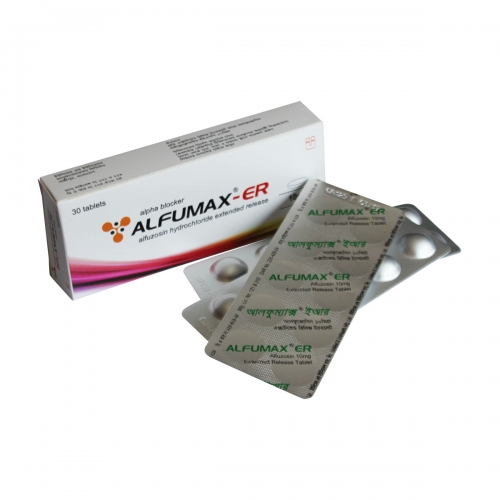
Alfumax-ER
Presentation
Alfumax-ER tablet: Blue, round shaped, film coated tablet; each extended release tablet contains Alfuzosin Hydrochloride USP 10mg.
Indications
Treatment of the functional symptoms of benign prostatic hyperplasia (BPH).
Dosage and administration
Alfumax-ER (Alfuzosin Hydrochloride) tablet should be swallowed whole.
BPH: The recommended dose is 10mg (one Alfumax-ER tablet) to be taken once daily after a meal. AUR: In patients 65 years and older, 10mg (one Alfumax-ER tablet) daily after a meal to be taken from the first day of catheterisation. The treatment should be administered for 3- 4 days, 2-3 days during catheterisation and 1 day after its removal. In this indication no benefit has been established in patients under 65 years of age or if treatment is extended beyond 4 days.
Paediatric Population: Efficacy of Alfuzosin Hydrochloride has not been demonstrated in children aged 2 to 16 years. Therefore Alfuzosin Hydrochloride is not indicated for use in the paediatric population.
Contra-indications, warning etc.
Contra-indications: Alfuzosin Hydrochloride tablet is contraindicated for hypersensitivity to Alfuzosin Hydrochloride, history of orthostatic hypotension, combination with other alpha-1 receptor blockers, hepatic insufficiency.
Warning and precautions: As with all alpha-1-blockers in some subjects, in particular patients receiving antihypertensive medications or nitrates, postural hypotension with or without symptoms (dizziness, fatigue, sweating) may develop within a few hours following administration. In such cases, the patient should lie down until the symptoms have completely disappeared. These effects are transient, occur at the beginning of treatment and do not usually prevent the continuation of treatment. The patient should be warned of the possible occurrence of such events. As with all alpha1-receptor blockers, Alfuzosin Hydrochloride should be used with caution in patients with acute cardiac failure. Care should be taken when Alfuzosin Hydrochloride is administered to patients who have had a pronounced hypotensive response to another alpha-1-blocker. Treatment should be initiated gradually in patients with hypersensitivity to alpha-1-blockers. Alfuzosin Hydrochloride should be administered carefully to patients being treated with antihypertensives. Blood pressure should be monitored regularly, especially at the beginning of treatment. Patients with congenital QTc prolongation, with a known history of acquired QTc prolongation or who are taking drugs known to increase the QTc interval should be evaluated before and during the administration of Alfuzosin Hydrochloride. In coronary patients, the specific treatment for coronary insufficiency should be continued. If angina pectoris reappears or worsens Alfuzosin Hydrochloride should be discontinued. As there are no clinical safety data available in patients with severe renal impairment (creatinine clearance < 30ml/min), Alfuzosin Hydrochloride 10mg prolonged released tablets should not be administered to this patient group. Patients should be warned that the tablet should be swallowed whole. Any other mode of administration, such as crunching, crushing, chewing, grinding or pounding to powder should be prohibited. These actions may lead to inappropriate release and absorption of the drug and therefore possible early adverse reactions. The ‘Intraoperative Floppy Iris Syndrome’ (IFIS, a variant of small pupil syndrome) has been observed during cataract surgery in some patients on or previously treated with alpha-1-blockers. Although the risk of this event with Alfuzosin Hydrochloride appears very low, ophthalmic surgeons should be informed in advance of cataract surgery of current or past use of alpha-1-blockers, as IFIS may lead to increased procedural complications. The ophthalmologists should be prepared for possible modifications to their surgical technique. Alfuzosin Hydrochloride 10mg prolonged release tablets contain hydrogenated castor oil which may cause stomach upset and diarrhoea.
Drug interactions: Combinations contra-indicated: Alpha-1-receptor blockers. Combinations to be taken into account: Antihypertensive drugs, nitrates, potent CYP3A4 inhibitors such as ketoconazole, itraconazole and ritonavir. Repeated 200mg daily dosing of ketoconazole, for seven days resulted in a 2.1-fold increase in Cmax and a 2.5-fold increase in exposure of Alfuzosin Hydrochloride 10mg when administered as a single dose under fed conditions (high fat meal). Other parameters such as tmax and t1/2 were not modified. Cmax and AUC of Alfuzosin Hydrochloride 10mg, when administered as a single dose under fed conditions, increased 2.3- fold and 3.0- fold, respectively following 8-day repeated 400mg ketoconazole daily dosing. The administration of general anaesthetics to patients receiving Alfuzosin Hydrochloride could cause profound hypotension. It is recommended that the tablets be withdrawn 24 hours before surgery.
Other forms of interaction: No pharmacodynamic or pharmacokinetic interaction has been observed in healthy volunteers between Alfuzosin Hydrochloride and the following drugs: warfarin, digoxin, hydrochlorothiazide and atenolol.
Use in pregnancy and lactation: Due to the type of indication this is not applicable.
Side effect: Classification of expected frequencies: Very common (<1/10), common (<1/100 to <1/10), uncommon (<1/1,000 to <1/100), rare (<1/10,000 to <1/1,000), very rare (<1/10,000), not known (cannot be estimated from the available data). Within each frequency grouping, undesirable effects are presented in order of decreasing seriousness. Nervous system disorders: Common: faintness/dizziness, headache; Uncommon: syncope, vertigo, malaise, drowsiness. Eye disorders: Uncommon: vision abnormal; Not known: intraoperative floppy iris syndrome. Cardiac disorders: Uncommon: tachycardia, palpitations, hypotension (postural); Very rare: New onset, aggravation or recurrence of angina pectoris in patients with pre-existing coronary artery disease; Not known: atrial fibrillation. Vascular disorders: Uncommon: hypotension (postural), flushing. Blood and lymphatic system disorders: Not known: neutropenia, thrombocytopenia. Respiratory, thoracic and mediastinal disorders: Uncommon: rhinitis. Gastro-intestinal disorders: Common: nausea, abdominal pain; Uncommon: diarrhoea, dry mouth, vomiting; Not known: vomiting. Hepatobiliary disorders: Frequency unknown: hepatocellular injury, cholestatic liver disease. Skin and subcutaneous tissue disorders: Uncommon: rash, pruritus; Very rare: urticaria, angioedema. Reproductive system and breast disorders: Frequency unknown: priapism. General disorders and administration site conditions: Common: asthenia; Uncommon: flushes, oedema, chest pain.
Overdose: In case of overdosage, the patient should be hospitalised, kept in the supine position, and conventional treatment of hypotension should take place. In case of significant hypotension, the appropriate corrective treatment may be a vasoconstrictor that acts directly on vascular muscle fibres.
Pharmaceutical precautions
Store in a cool and dry place, protected from light
Packaging quantity
Alfumax-ER tablet: Carton containing 30 tablets in alu-alu blisters.
এই পাতাটি ৩৭৭ বার দেখা হয়েছে